
Captain Zina Lewis: First Black Captain on the Kennebec River
Our newest exhibit, Re|Sounding, includes recently uncovered archival documents that provide insight into undertold stories of the state’s Indigenous and Black maritime communities, celebrating resilience and tradition while shedding light on a global history of colonization and enslavement. The features both historic artifacts and artworks of contemporary Black artists to deliberately invite dialogue on the ways history continues to shape the present, prompting visitors to imagine futures founded on equity and freedom. For those who have seen the exhibit, the name Captain Zina Lewis might sound familiar—let’s take a closer look at the story of the first Black captain on the Kennebec.Born sometime in 1819 or 1820, Zina Lewis was born to Thomas “Tom” and Esther Lewis of Gardiner, one of many descendants of a man named Isaac Hazard Stockbridge who was enslaved by Dr. Silvester Gardiner in 1766. From the recollections of Gardiner’s grandson Robert Hallowell Gardiner, we confirm that Tom Lewis was the grandson of Hazard, referred to here alternatively as “Hasard.”.
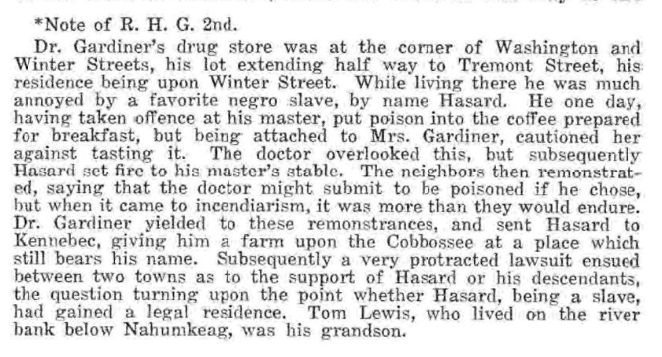
Early recollections of Robert Hallowell Gardiner
It has been suggested that inventor Robert Benjamin Lewis’s mother was Lucy Stockbridge, who was the daughter of Isaac Stockbridge and his wife Cooper Loring, making Robert a relative of Zina Lewis. Additionally, in 1852’s edition of the History of Gardiner by J.W. Hanson, he asserts that “All the colored people named Lewis in this vicinity [Hallowell] are descended from Hazard.”
Thomas Lewis himself was a sailor, having shipped out on the Harpswell schooner Argonaut in August of 1810. Twenty-six years later, on November 18, 1836, 17-year-old Zina registered his own seaman’s citizenship affidavit at the custom house in Bath, just downriver from his family’s home. His younger brother James followed suit in 1842.
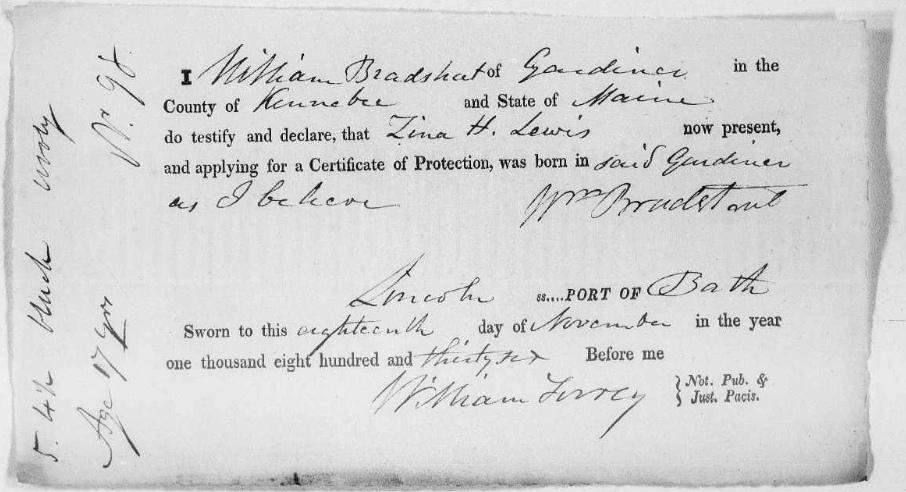
Seaman’s Protection Certificate, issued at the Bath Custom House in 1836, via ancestry.com
Thomas Lewis died in 1856, and the records of Thomas’s estate show that among his few possessions was a gundalow, a wide, flat-bottomed boat with a very shallow draft. Gundalows were in common use on New England rivers since at least the mid-1700s, often for harvesting and moving salt hay growing along the mudflats of tidal rivers like the Kennebec. Salt hay grows wild and does not need cultivation, and is an important crop for livestock, especially in winter. Having a flat-bottom boat with a shallow draft makes the work of harvesting salt hay easier, regardless of the tide. It is easy to imagine that his father’s possession of a gundalow and his own sailing background inspired Zina to eventually build his own ship and sail the Kennebec, a river he would have been very familiar with.
Zina worked both as seaman and a small-scale farmer. He married a woman from New Brunswick named Mary, and his family grew to include sons William T., George C., and daughter Mary who was called Etta.
By 1871 Zina had built and launched his first vessel from the banks of the Kennebec in Gardiner. He gave his 48 foot scow sloop the formidable name of Dreadnaught. With that, he became Captain Zina Lewis, and the only Black captain on the Kennebec.

From the city directory, 1882.
As his work expanded so did his mentions in local papers. His scow vessels were referred to as “lighters” and were small and versatile, and perfect for being able to navigate not only the shallows of the Kennebec river but the hazards of the open sea as well. Goods like timber, lumber, and ice were shipped downriver and goods that couldn’t be produced in Maine such as iron, sugar, flour, and cotton textiles, were shipped up. Despite his constant hard-working presence in the working waterfront community, racism was ever-present in Captain Lewis and his family. A birthday party was thrown for his daughter Etta when she turned 21 and was covered in the Kennebec Journal with truly revolting racist language. What should have been a joyous celebration for her was marred by deep prejudice.
In May of 1883, Captain Lewis’s newest scow Argo was lost at Small Point, Maine, having dragged anchors and run aground. The Kennebec Journal, the same paper that mocked his daughter’s birthday party two years before, remarked that even though his loss was about a thousand dollars “he has good grit and has contracted with a party in Perkins to build him a new one.” And a few short months later in July the Kennebec Reporter proudly reported that “On Tuesday Captain Zina H. Lewis had his new lighter towed up river loaded with lumber”.
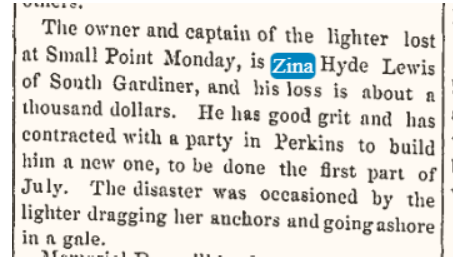
Kennebec Reporter, May 26 1883
Over the course of the next two years roughly twelve newspaper articles were written about him and his activities up and down the Kennebec, from Portland to Bath to Gardiner. He would have been a familiar face to those along the river, ferrying goods from all over Maine.
In early December, while hauling 52 tons of iron from Portland to a company in Bath, Captain Lewis’s scow sloop Corinna was caught in a terrible snow storm in Sagadahoc Bay, unable to reach the mouth of the Kennebec. We are lucky to have Captain Lewis’s own words, taken from an interview he granted the Bath Times:
“[...] We intended to run up into the Kennebec but a thick snow storm set in and a heavy sea was running. The wind was then southeast and blowing heavy and the sea making fast. It was so thick that we gave up trying to get into the Kennebec. Let go another anchor and made preparations to ride out the blow. Wind steadily increased and thick snow, followed by rain, prevailed; the sea washed our decks during the night. We feared that the heavy sea would strain the scow and set her leaking so badly that she would go down.”
The crew of three, Captain Lewis and crew members Lewis Dojay and Charles Westorn, persevered through the night, but discovered at 8:00 am the next morning that the Corinna had sprung a leak. Taking on a foot of water in less than half an hour and fearing for their lives, the crew made the decision to clear the deck of the iron in an attempt to lighten the load. According to Captain Lewis,
“To keep the scow, which was fast settling, from going down, all hands set to work throwing the deck load over. We were obliged to hold on with one hand to keep from being swept from the deck, and shove the iron over with the other.”
When all seemed lost, Captain and crew happened to look up and see Captain Haley and the crew from the Hunnewell’s Point Life Saving station approaching in their own boat through the rough seas. Captain Lewis states that but for the timely assistance rendered by Captain Haley and his crew, himself and two men must have been lost, as they would never had reached the shore in the small boat. The paper then reports that “[Captain Lewis] is strong in his praise of Captain Haley and crew”.
Despite the hardships after hardship, Captain Lewis continued his work until the very end with the determination and “good grit” so often reported on.
The last time we see Captain Lewis in the newspaper is in the August 1888 issue of the Times Record, fondly recalling “Bath’s Veteran Lighterman”. He was a familiar figure in Bath for more than thirty years, raising a family and making a living in the face of incredible odds.
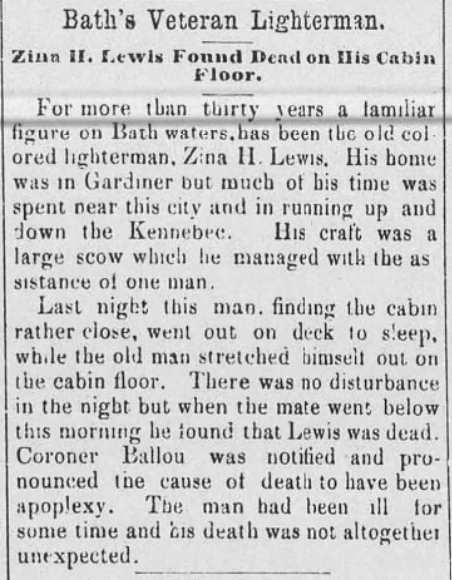
Editor’s Note: One of the most common misconceptions about Maine and other New England states is that the institution of slavery did not affect “The North” and that New England has always been a safe haven for the fight against slavery. Although New England residents did not participate in the large-scale plantation slavery people are familiar with, people were still enslaved in Maine into the late 1700s. In Patricia Q. Wall’s book “Lives of Consequence”, she finds evidence of as many as 500 enslaved people in present-day Kittery, Eliot, Berwick, and South Berwick. Even after slavery was outlawed in Massachusetts (and thus Maine) in 1783, Maine-built ships continued to trade in molasses, cotton, and rum– all products of the “triangle trade”. Free and enslaved people of African descent have lived in Maine since as early as 1600, working the waters and the land. The contributions made by these women and men may have been hidden, but they are no less important to the fabric of Maine’s maritime history.