
Dead Reckoning: Shipyard Death & Disturbances Audio Transcript
An accompanying transcript for the after-dark audio tour
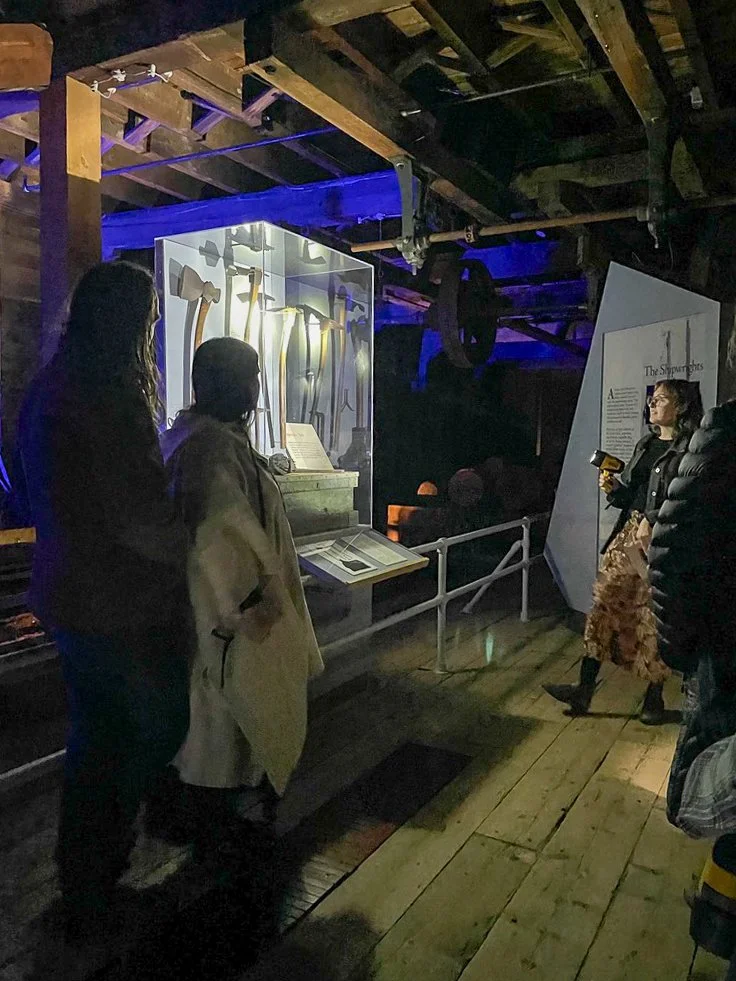
Tour Intro
The spaces that you are about to enter were a part of an industrial center of shipbuilding in the 1800’s and early 1900’s. The Percy and Small shipyard operated from 1894-1920, and the Donnell family home was built in the 1840’s, adjacent to the Deering and Donnell Shipyard, which later became the William T. Donnell Shipyard.
These stories were uncovered through newspaper accounts, back when public reports of accidents did not shy away from all of the gruesome details. All of the stories that you will be told tonight are true- experienced by real people in the past, and in some cases, real people in the present day, perhaps encountering spirits from the past…
Retelling these stories breathes life into the histories of the people living and working on this land. What is currently a place to relax and learn was once a place of hard work and tragedy. In respect for these workers, we tell stories to honor their lives.
The Percy & Small Shipyard built schooners for the coal trade, including the largest wooden vessel in North America—Wyoming. A majority of construction was done using only hand tools, pulleys, and horses. There were plenty of opportunities for accidents, no safety regulations, no safety nets or barriers.
If you were a shipyard worker in the 1800s that worked a 30 year career…you had a 50% chance of sustaining a serious injury. Before 1915, employers largely not liable. The Fellow Servant Rule served as a protection for employers, if an accident is the fault of another worker, it was not the employer's fault. The buildings you will be entering are the original buildings that were on these grounds in the 1800’s .
As you move through this tour, be aware of your surroundings. Spirits speak subtly through the environment around us. Perhaps a flash of a light, a shadow in the corner of your eye, or a sudden rush of cold wind.
Location: Blaisdell Pier
This pier was the scene of many exciting times during Percy & Small’s heyday. It witnessed huge schooners sliding by on their way into the Kennebec, and also welcomed them back for repairs after the many accidents and disasters that befell them on the high seas. But accidents and disasters can occur anywhere at any time, as these stories will prove.
Ephraim Toothaker
On a cold Tuesday afternoon in December 1910, caulker Ephraim Toothaker was killed in a grisly and unlikely way. At 67 years old, an age when many modern people are enjoying retirement, Toothaker was still in the prime of his shipbuilding career. In a time without 401k’s or Social Security, many shipyard employees worked hard, dangerous jobs outdoors well into their seventies.
Although the huge vessels Percy & Small built were propelled by only the wind in their sails, much of their work was powered with mighty steam engines. These “donkey engines” did heavier lifting than a gang of men and horses could usually accomplish, including raising the massive anchors of the great schooners and maneuvering vessels from the river to the pier where they were repaired. But unlike a man or a horse, an engine doesn’t listen when it hears the word “stop.” You can scream at an engine all you like, but unless you can reach the off switch it churns on no matter what, or who, gets in its way.
The giant 5-masted schooner Dorothy Palmer was being pulled into the wharf for repair, using one of her donkey engines, when mate J.W. Hassell heard strange mechanical noises coming from deep down in the dark, freezing, wet, noisy chain locker, where the chain used to haul the giant vessel shoreward was gathered. Nobody should have been down there, so nobody went to check on the noise until it was too late.
Upon investigating, Hassell discovered a near-unrecognizable body—Toothaker’s—with its head crushed in the engine’s gears. It appeared that his coat had gotten caught up in the chain and pulled him, headfirst, link by link, into the engine’s inner workings.
Mercifully, Toothaker may have been strangled by his coat before getting crushed, but the doctor who attended the scene was not certain.
The mystery remains: what was Toothaker doing so close to the donkey engine? No one heard him cry out, and no one knew why he was within 15 ft of the chain. We do have one theory: many caulkers went deaf over the course of their careers. The incessant pounding of mallet on caulking iron, driving oakum into the seams between a vessel’s planks, day in and day out, was death to eardrums. Perhaps Toothaker couldn’t hear the clanking and grinding of the engine behind him until it was too late, and he was caught, being dragged in, looking his own death in the face.
Philip Corrogon
Our next pierside accident occurred in late May 1890. Though late spring might feel like a safe time to be working outdoors, the Kennebec River takes no prisoners in any season.
Workman Philip Corrogon, only 39, was well-liked and considered to be a hard worker. Perhaps that’s why his boss chose him for an errand as dusk began to fall on his last night alive.
Mr. Spear of the Kelley-Spear shipyard asked Corrogon to fetch a small boat that was located on a scow tied up to the pier. After waiting far too long for Corrogon’s return, a frustrated Mr. Spear went to find out what the holdup was.
The small boat still sat on the scow unmoved. Corrogon was nowhere to be found, but his oilcoat was placed in the boat as if he’d just stepped away for a moment. Walking away from a job was highly uncharacteristic of Corrogon.
The alarm was raised and a fruitless search conducted. Corrogon’s friends at his boardinghouse hoped he’d turn up safely before morning. He never did.
The next morning a man with a grapple was engaged to fish for clues near the scow. A hat was dredged up first, likely belonging to Corrogon, and shortly after his body was raised on the hook, miraculously not swept away with the tide.
Corrogon’s body had a small cut above the right eye, and he was missing a single rubber boot. The coroner was called and it was ruled that no further inquest was necessary. Corrogon had likely fallen into the river, striking his head on the way down, ultimately drowning close to shore and his friends, yet far from his home and family in Prince Edward Island. In the quiet after hours along Bath’s waterfront, the busy 10-hour day concluded, no one was there to hear the splash or reach out a hand to save Philip Corrogon who drowned so close to shore.
Fiddler’s Reach
Drownings on the Kennebec weren’t solely unique to shipyard workers. Many rumors and legends describe how the section of river just beyond the bend looking south got its name: Fiddler’s Reach.
The two stories we’ve already told here, of Ephraim Toothaker and Philip Corrogon, are factual. We consulted books and newspapers to confirm every gruesome detail. This story is apocryphal, but has just enough fact in it to be believed.
Before the invention of the donkey engines that killed Ephraim Toothaker, human strength and mechanical advantage were the only tools that could move a huge oceangoing vessel when the wind died. Often, vessels making their careful way up the Kennebec would be becalmed in the stretch of river just around the bend. To continue their progress, crews would “kedge” their vessels upriver. They would load one of their heavy anchors into a rowboat, row as far from the vessel as they could, drop the anchor, and then inch by inch winch themselves up to the anchor before repeating the process. The men laboring at the capstan or windlass, cranking thousands of tons of wood and cargo against the current, needed a rhythm to work to, and a musician was often employed to make the backbreaking work easier and more enjoyable.
Perhaps this is Fiddler’s Reach because of the frequent tunes one could hear drifting up from the river. Perhaps, some say, the name is more sinister. Legend has it that one fiddler, enthusiastically sawing away on his vessel’s bow, fell overboard and drowned. On some nights, you can still hear the sound of his fiddle playing on from the Reach.
Location: Wyoming Evocation
This site, currently holding the Wyoming Evocation, is one of two sites on this shipyard where great schooners such as the one whose skeleton is before you would be constructed.
Let’s take advantage of the view of the shipyard from this site to tell you our next couple of stories.
James Tobey
Not even the father-in-law of one of the shipyard’s owners was safe from hazardous working conditions. James Tobey, whose daughter married Sam Percy, worked as a dubber, smoothing the heavy frames of ships under construction with heavy tools. Like Toothaker, he was still going strong in his late 60s. In fact, Tobey was just shy of his 70th birthday in 1897 when he went plummeting down into the hold of the schooner H. E. Thompson, undergoing repairs at the shipyard.
His body wasn’t missed until after the yard closed for the evening, and his broken body was found down in the hold after 10 o’clock at night. But Tobey wasn’t dead; he hung onto life with a fading grip for another day, and had the good fortune to die in his home, surrounded by family.
Now it might seem shocking that such an important member of a shipyard owner’s family would suffer the same injury as many common workers, but in fact this incident was not the first such fall for James Tobey. Just one year before, Tobey had sustained a similar fall, but had gotten up and walked away with only a few broken bones. Still, misfortune found him in the end, and no close connection to the boss could save him from an all-too-common fate.
Columbus P. Nash
This site has a great view of what is considered one of the most dangerous buildings on the shipyard: the Mill Building, where planers and saws sent wood chips flying with such power and force they would dent the walls. Along with those planers and saws, known to take limbs and in some cases lives, were other handheld tools workers relied on heavily, but which also had been known to turn against them a time or two.
It was on this very yard where Columbus P. Nash was working as a ship carpenter. One September morning, he found himself under a schooner with his adze.
It was as ordinary a day as it could be on a shipyard, 63 year old Nash no stranger to the commotion this type of job site brings. Little did he know, fate had a surprise in store for him.
As he meandered under the hull of the great schooner, as he had done with countless others many times before, his legs were suddenly swept out from under him by a line attached to a plank being pulled by a pair of horses.
Nash likely saw the world around him turning violently, as he was thrown off balance and into the air, no time to anticipate it would be the adze he was carrying which would break his fall.
With a punctured abdomen, he was sent home to await treatment.The next day two doctors from Portland would inform him the wound was not simply superficial – the adze had caused a rupture along with other internal injuries. Too weak to be operated on, Nash was left to die the following day.
Was he aware these two days after his accident would be his last alive? Or was he merely slipping in and out of consciousness, unknowingly dragged, ever so slowly, into permanent darkness?
Morton J. Sandford
While falls were not uncommon on the shipyard, one in particular stands out as an oddity. It has simply too many commonalities to be anything but cursed.
Isaac Small, a worker on the Percy and Small Shipyard, was just back to work, still sore from a fall in which he narrowly escaped death on a hot August morning. Amid the jumble of noise and moving parts around him, Isaac was unable to find his workmate, Morton Sanford, and realized that it had been about 30 minutes since he had last seen him. Navigating back to the place he had seen his workmate, the sounds of workers and equipment seemed to retreat, and his uneven breathing echoed loudly in his ears. Looking down the hatch of the schooner being repaired in the yard, Isaac’s gaze was met with a sight that no man would want to encounter. There, twenty feet below in the hold of the schooner, was the body of Sanford- silent, unmoving, in an unhuman position. Morton Sanford had been working alone at the time of his fall, and likely died on impact, breaking his neck.
His workmate surviving a similar fall less than a week prior to the fall that took Sanford’s life seems a minor coincidence after learning about the fate of the previous inhabitant of his home on Pleasant street.
John Avery
John Avery was a truckman in the shipyard parallel to the Percy and Small shipyard. On a crisp spring morning, Avery was assisting with the unloading of timber from a schooner at the wharf via horse and wagon; his trips to and from the wharf becoming monotonous, lulling him into a false sense of security. It was a chain that would unravel a string of events that would change Avery’s fate forever, when it shifted on a stick of lumber, leading Avery to set his reins down to adjust it. As he was moving the chain, his horse started, catching Avery between the horse and the wagon shafts, leaving him unable to move. Avery had only a few moments between getting stuck and a wheel striking the end of a timber, and—
CRASH!
The strike of the timber instantly overturned the load, taking the horse with it, throwing it on its side. Avery, still stuck between the horse and the wagon shaft, seemed to disappear beneath the great creature, appearing larger than ever. When the horse was eventually brought back to its feet, John Avery was revealed, unconscious but alive, and taken to the mill building. The glimmer of hope in his fellow workmates’ eyes began to fade as his injuries were revealed. Avery’s left side was completely crushed from the shoulder to the hip, his ribs being torn from his backbone. It is a wonder that he even survived the 10 minutes following the accident, before becoming another tragic, cautionary tale.
These stories are only a few that became woven into the shipyards’ fabric, standing as chilling reminders of risks that came from laboring on and above the shipyard ground.
Location: Donnell House Lawn
This house is known among staff to be the most haunted building on campus, so please remember to keep flashlights low and heads on a swivel, and show your respect- we are the guests here after all.
This is the family home of the Donnells—a family of 6—a family that seemed to be incapable of escaping the grips of death, no matter how much wealth or love they may have shared, they all met misfortune.
Clara
William and Clara Donnell wed in October of 1860, and had their children: Harry, Gussie, William, and Addiella. The family was very active politically and socially, both parents and children hosting many social events in this very space
When Clara was 51 years old, just 10 years after giving birth to her last child, Addiella, she fell ill with pneumonia- an almost certain death sentence at the time. It was a brief illness, taking her from her husband and children not long after (1890).
The Donnell family mourned the loss of their beloved mother, keeping her body in the parlor for her viewing and funeral.
I’d like to tell you that is the last body that was brought and held in that room, but that would not be the truth.
Addie
The library of this house holds a portrait of the youngest Donnell daughter, Addiella. Addie, as she was more affectionately known, was a bright, creative, and outgoing young woman, a well-known and well-liked member of the community.
Fourteen years after the death of her mother, Addie was on the track to a happy life. She was a 24 year-old woman at the time, engaged to be married.
Her life was briefly interrupted with an unexpected hospitalization in Portland for appendicitis. She had a seemingly successful surgery to remove her appendix, and she was recovering in the hospital, likely feeling relief from the pain she had so recently had to endure, when she began to experience a new sensation- an infection that was destroying her body, one damaged organ at a time- until she died 3 days later, never having married or moved out of her family home.
It was Addie’s brothers who had to retrieve her body from the hospital in Portland and bring it back to this house, in the parlor, right where their mother’s body was on display years before.
Unexplained Encounters
The museum sits among a residential neighborhood, where many of the homes belonged to the blue-collar shipbuilders of the 1800s.
A few years back, one local neighbor, who often passes by this house on evening walks, noticed something suspicious after hours.
As they meandered by on the sidewalk, they saw a figure sitting on the roof of the front porch. It appeared to be a woman in an elegant dress. As the neighbor approached the fence to the house, the figure retreated through the second floor window, knocking one of the window shutters out of place.
Thinking it a bit strange, the walker supposed it was possibly a museum employee, so they left.
On the next night they saw the figure again…and again she retreated through the window.
Out a bit earlier than usual the next day, this walker thought to report the unusual activity to the boatshop crew still on duty—who did agree the shutter was indeed out of place when the neighbor pointed this out.
After confirming no activity on behalf of the museum was happening at night and the house was locked and armed with a security system per usual, the employee went to check it out. They approached the window to see if it had been tampered with. What they discovered was extremely mysterious… The window was bolted shut. As it had been for decades….
Unexplained Encounter #2
This next story also involves the front upstairs bedroom whose window the figure in the previous story used to enter the house.
A few years back, the museum was preparing for a Christmas-themed Victorian party in this home. The young daughter of a museum staff member and her friend had arrived early with her father to begin preparing to be volunteers dressed in period costume. After showing them to the front bedroom upstairs, the father stepped out of the room to give the girls privacy as they changed into their dresses.
While they were getting ready, they heard footsteps in the hallway, just outside the bedroom door. The daughter called out to her father, expecting him to be impatiently waiting. She received no response. She called again, “Dad?”
Again, no response, and yet they heard footsteps walk away and fade into the distance. The girls hurriedly finished getting ready and went downstairs as her father returned from outside
Confused to see him coming in from outside, the staff member’s daughter asked why he didn’t respond when she called out, he said, “you two were the only ones in the house”...
Unknown to them, he had left the house to retrieve supplies from his vehicle.
There have been no certain explanations for the figure, shutter, or footsteps in this house since the incidents
Could it be Addiella, reliving one of her family’s social gatherings or waiting for her fiance to come and finally take her away to their new life they had planned?
Could it be Clara, looking for her family that she was forced to abandon too soon?