
Maine Women Shipbuilders Assisting in WWII
Founded in 1884, Bath Iron Works has a long and storied history that looms large in our community—this is, after all, the City of Ships. But did you know that Bath Iron Works also had a satellite yard in South Portland, assisting in the manufacture of Liberty Boats?
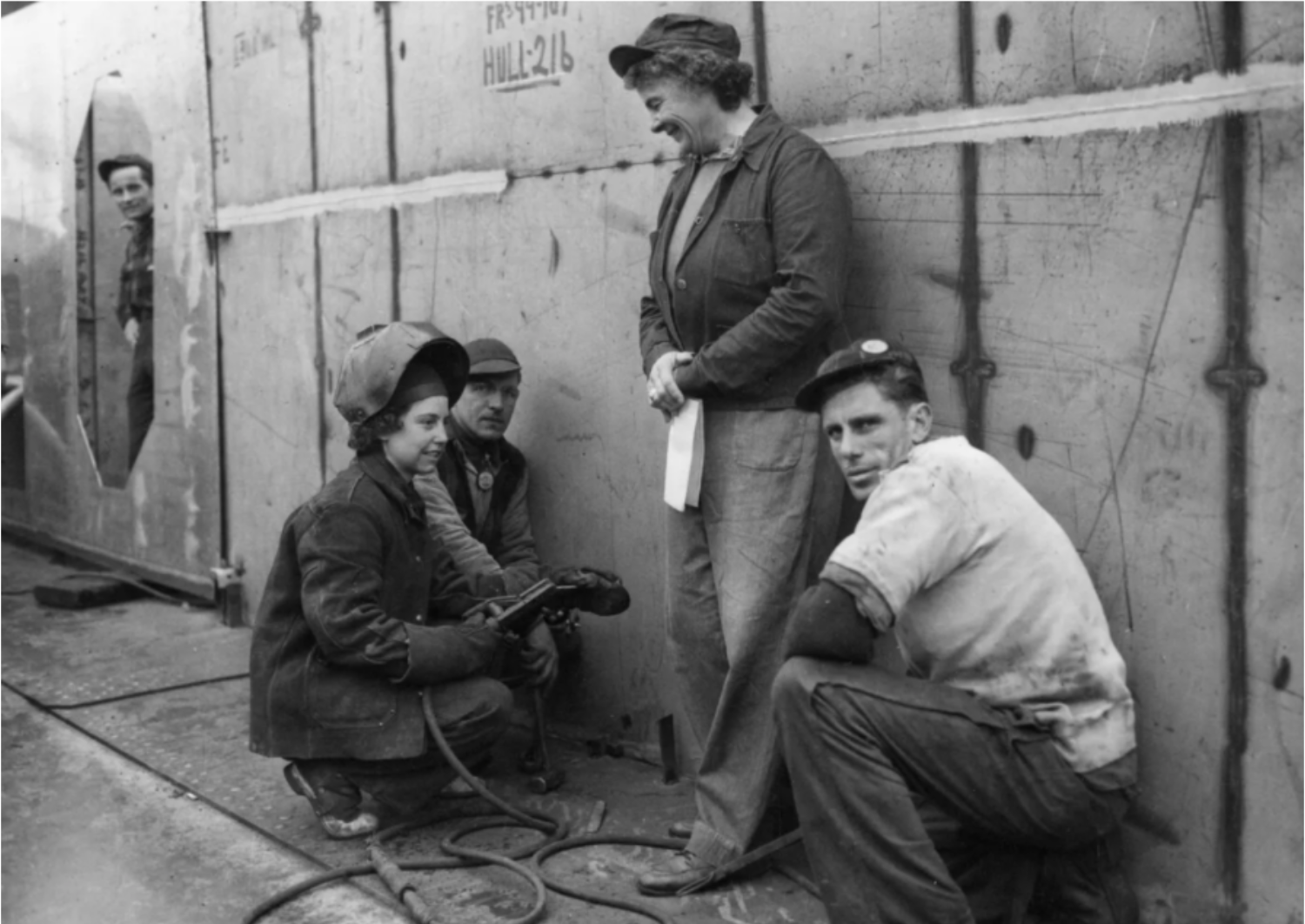
Men and women welders working on the USS Cogswell at Bath Iron Works, 1943
At the start of World War II, shipyards in Maine saw rapid expansion in response to the demand for more cargo ships. In 1940, Todd-Bath Works, a joint operation between Todd Shipyard and Bath Iron Works to build Ocean class cargo ships for Britain, began laying keels in South Portland. Once the British quota was met, manufacturing then switched to Liberty class ships. Liberty ships were cargo ships, mass-produced to meet the demands of resupplying troops. South Portland Shipbuilding Corporation began building ships alongside Todd-Bath in 1941, and the two yards were combined as New England Shipbuilding Corporation in 1943, operating independently from Bath Iron Works. At its peak, the shipyard employed 30,000 people, and stretched across the entire South Portland waterfront, all the way from Southern Maine Community College and Spring Point Light to Bug Light.

Commemorative pennant, 1942. PHM1988.4.4
By March of 1943, 2300 women were employed at South Portland Shipbuilding Corporation, making up 9% of the workforce. Additionally, the shipyard was the first in the country to employ women in the Rigging Loft. It took an average of 39 days to build and launch a Liberty ship, all due to the hard-working men and women shipbuilders.
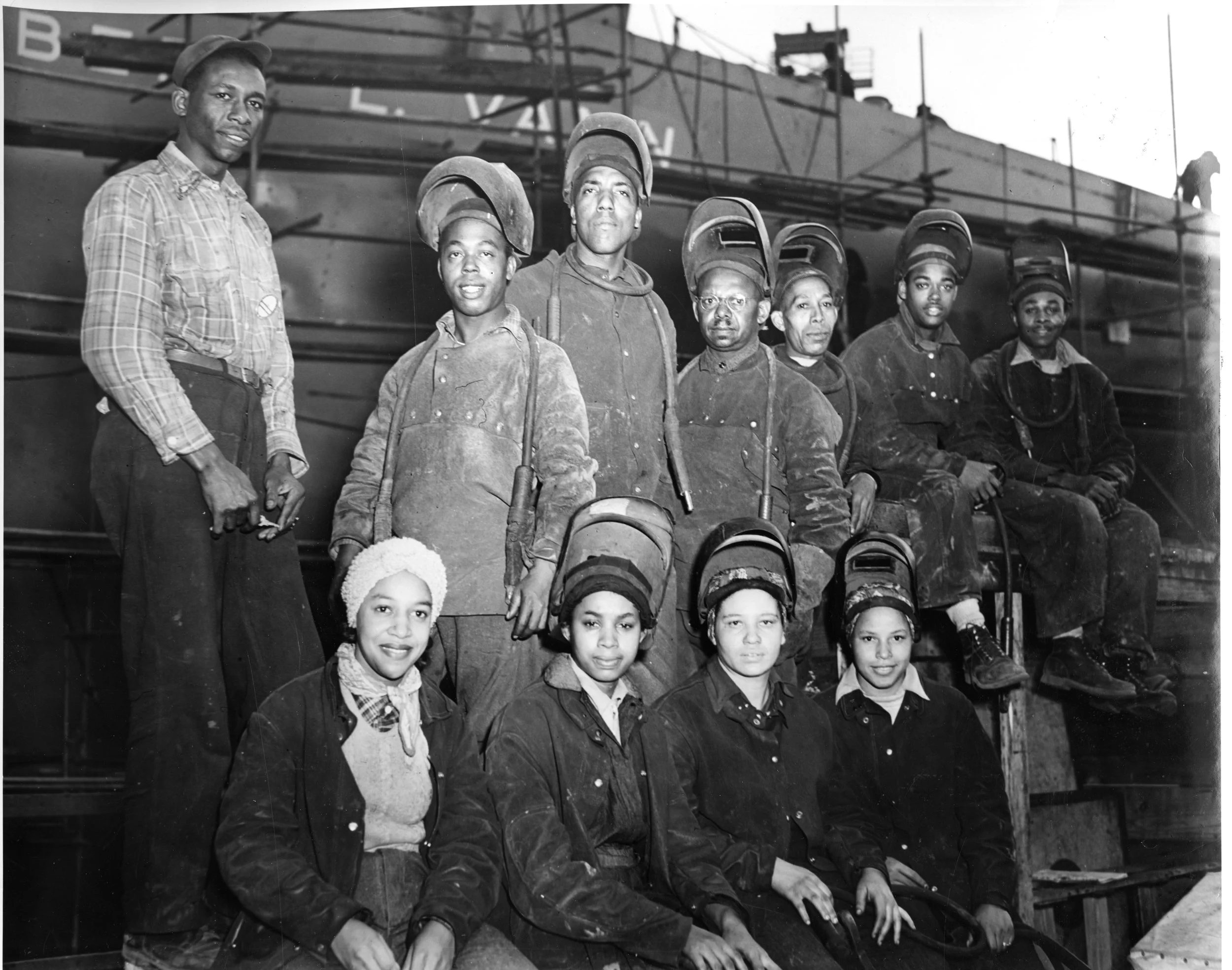
Black welders, New England Shipbuilding Corporation, 1943. Photo collection 29.3

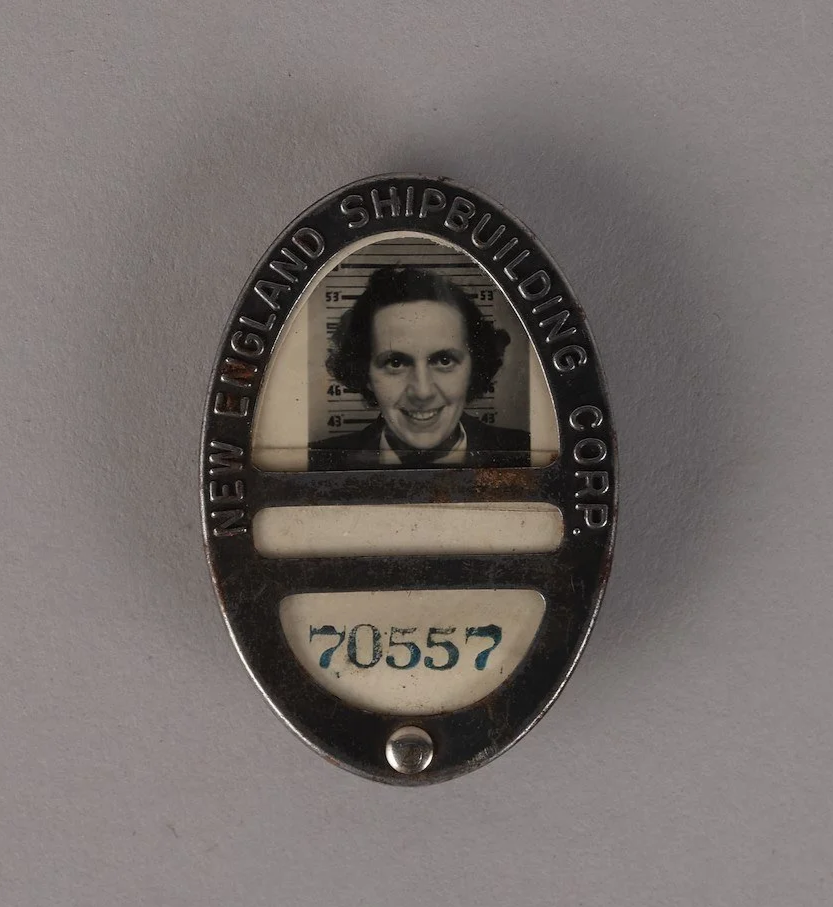
ID badges of two women shipbuilders at New England Shipbuilding, 91.118.021 and 89.057.032
Women were an important part of the shipbuilding force, and often encouraged to apply for work alongside men in roles such as welding, riveting, painting, crane operation, and rigging. Ads in newspapers, such as one published in the Portland Press Herald in 1943 stated that “whatever your experience, ability, trade, age, sex– there’s a job for you in this essential war industry.” With many young able-bodied men overseas fighting in the conflict, many industries including shipbuilding were eager to hire anyone willing to further the American cause. Women especially were encouraged to trade dustpans and mops for riveting guns and welding torches.
And it wasn’t just Wendy the Welder, the image of a young, perfectly coiffed and made-up woman who encouraged to work to support her husband or brothers— women like Lillian Brenton, mother of five, went to work to support her sons in the service:

Evening Express, May 11 1943.
Lillian Brenton worked at New England Shipbuilding with her husband while their five sons were fighting in the Army Air Corps, and said in this advertisement from 1943 that, “It’s a comfort to know that these Liberty Ships I’m helping to build are bringing the end of the war closer.” Many women like Mrs. Brenton were eager to do their part.
The South Portland Keel (later the New England Keel) was a newsletter published for shipyard workers. The museum collections hold numerous copies of these newspapers in its archives, and a small section of it was also published in the pages of the Evening Express, reaching wider audiences than just shipyard employees. Because of these in the museum collections and online archives, we are able to hear directly from these women about their experiences.
Men and women shared their experiences working in the shipyard, and many women, like Geraldine Bishop from South Portland, remarked that “I would much rather build ships than do housework any day.” Her opinion was certainly shared with other women shipbuilders, who often wrote the same comment—the work was hard and days were long but it was better than keeping house.
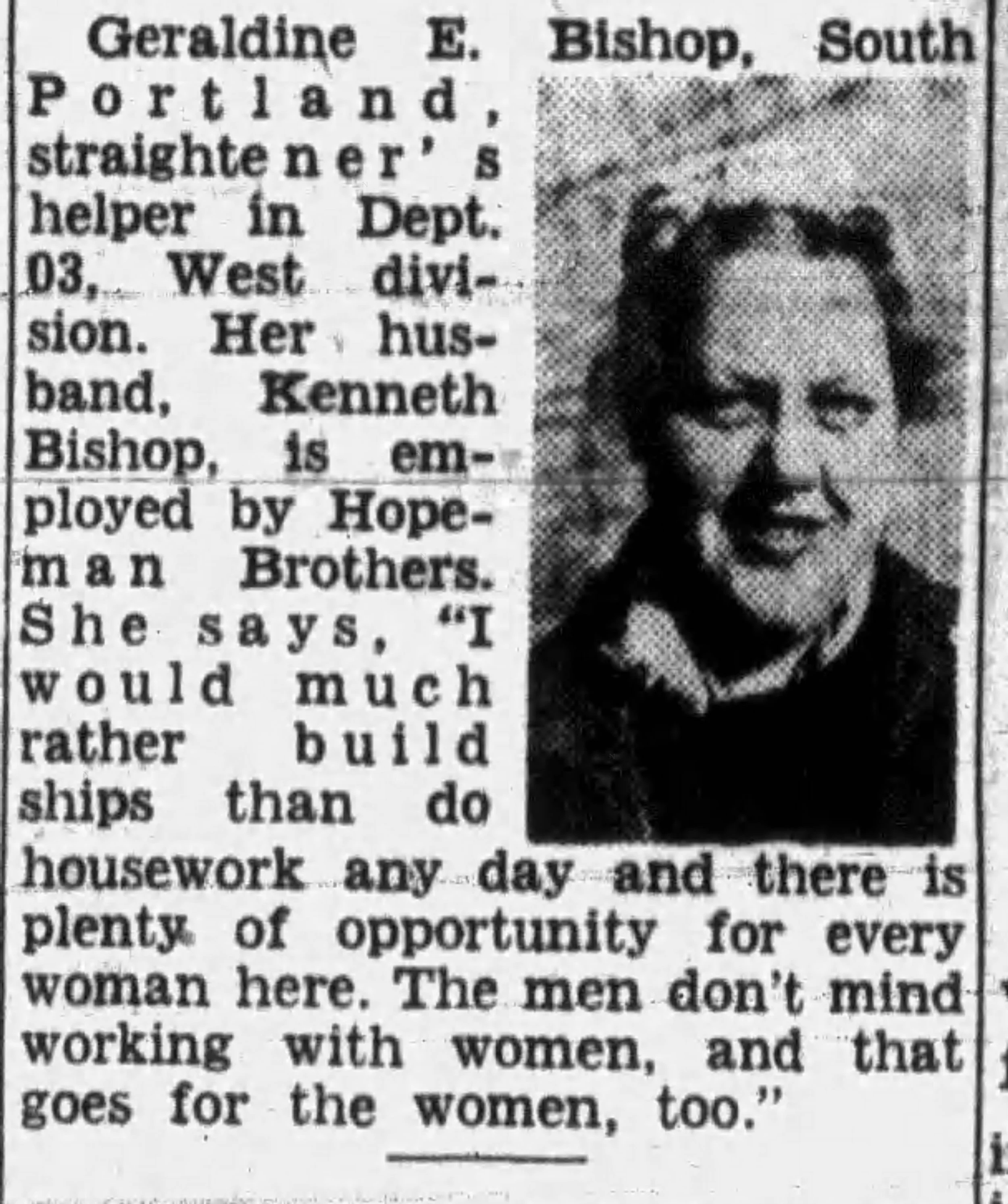
Evening Express, February 16 1943.
Gilda Plimmer of Old Orchard Beach said in 1943 that “Working on the ships is a new thing for women.” Would she have guessed that 83 years later women working on ships would be the norm for Maine? From Bath Iron Works to Windjammers, lobstering boats to oyster farms, women are involved in many maritime industries.

Evening Express, March 9, 1943
The South Portland shipyard closed in 1945 at the end of World War II. In four years, the women and men of the yard constructed 274 ships– 30 for the initial British order and 234 Liberty Ships. Two of those remarkable ships survive today. The SS Albert M. Boe is permanently moored in Kodiak, Alaska as a cannery ship named the Star of Kodiak, and the other is the SS Jeremiah O’Brien, a fully seaworthy museum ship moored in San Francisco.

Liberty Ships in Portland Harbor, J.O. Proulx, 1943. 97.128.1
The legacy of these shipbuilders lives on today. Bath Iron Works employs over 6,000 men and women who carry on the shipbuilding tradition from years ago, proudly manufacturing the best-built ships in Maine. Want to learn more? This summer would be a great time to book The Bath Iron Works Story: By Land and Sea Tour!